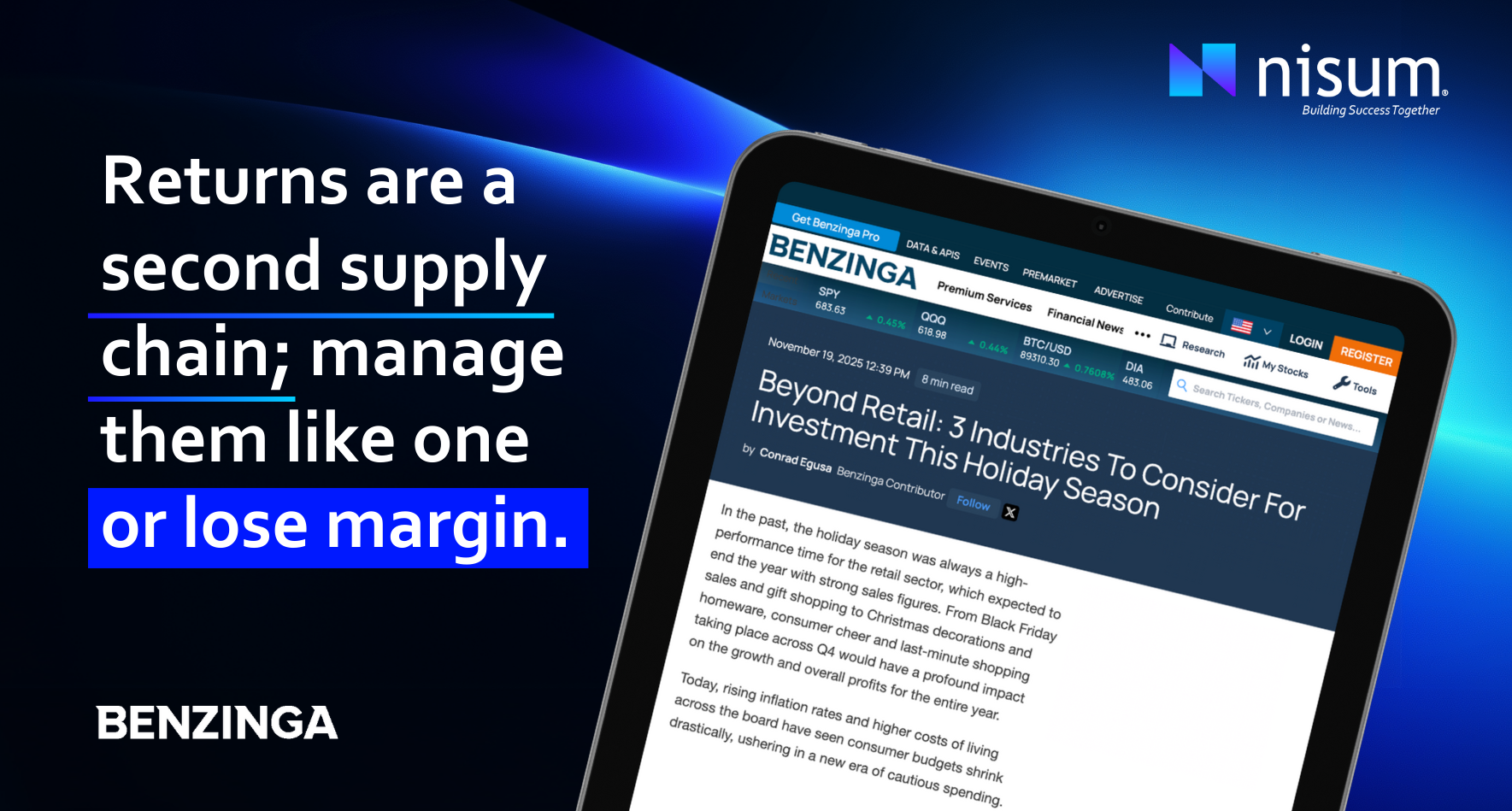
Holiday returns have quietly become one of the biggest controllable drivers of margin. Not because return rates are new, but because exception handling has become more expensive, customer expectations are less forgiving, and abuse patterns are more sophisticated. Benzinga recently featured Nisum and CEO Imtiaz Mohammady on the need for end-to-end visibility across the retail chain. [PRIMARY_LINK] The next step for enterprise leaders is converting visibility into a return operating model that moves faster, wastes less, and protects trust.
Executive takeaway: Returns are a second supply chain. Reduce avoidable returns by removing purchase ambiguity, standardizing intake and routing to increase returns velocity, segment disposition to recover value faster, and applying targeted controls to limit return fraud. End-to-end visibility is what ties customer experience to margin during peak season.
Why returns became a board-level margin lever
The real issue is not return rate, it is return economics. Returns create a compounding cost-to-serve problem: labor, transportation, customer care volume, inventory distortion, refund timing, and dispute leakage. When the system is unclear, teams default to manual work and inconsistent decisions. That is when returns stop being manageable friction and become a hidden tax.
Executives should treat returns as a flow with measurable throughput, just like fulfillment. If outbound has service commitments and operational cadence, inbound should too.
The executive shift: manage returns like a second supply chain
Returns are a second supply chain with its own demand peaks, constraints, and value decay. The organizations that do well build predictable intake, fast routing decisions, and clear disposition rules. That is what makes convenience sustainable. It also lays the foundation for targeted controls that deter abuse without penalizing legitimate customers.

Returns are a second supply chain; manage them like one or lose margin.
Lever 1: Prevent avoidable returns by reducing purchase ambiguity
The cheapest return is the one that never happens, but prevention cannot mean friction. The practical move is to reduce ambiguity: accurate product content, consistent sizing and fit guidance, realistic delivery promises tied to capacity, and responsive support that resolves pre-purchase uncertainty. The goal is fewer “just in case” orders, which lowers reverse shipping, handling, and customer care load without tightening policies.
Lever 2: Increase returns velocity with disciplined intake and routing
Returns value decays with time. Every day an item sits unverified or unassigned increases handling cost and decreases resale opportunity. That is why returns velocity is a strong KPI: time from return initiation to final disposition decision. Leaders improve velocity by standardizing intake and automating routing rules, so items do not bounce across teams in a “pending decision” state.
This is also where credibility matters. In a Fortune 500 context, a store capacity management approach that improved operational visibility enabled more reliable store pickup execution and was associated with reported outcomes including a significant revenue lift and meaningful shipping cost savings in a short period. The transferable lesson is simple: when the operating system can see capacity and constraints clearly, it can make faster, better decisions. Returns velocity works the same way. Visibility only matters when it drives routing and disposition decisions at speed.
Lever 3: Recover value with segmented disposition, not one-size-fits-all
Not all returns should follow the same path. A sealed item, a lightly used item, and a damaged item have different economics. The margin game is deciding early and executing consistently. Segmentation should shorten the time from receipt to outcome, whether that outcome is resale, refurbish, repair, liquidation, donation, or recycle. Most leakage comes from slow or inconsistent decisions, not inevitability.
Lever 4: Treat return fraud as enterprise risk, not a customer service edge case
Return abuse ranges from policy exploitation to item switching and false claims. A blanket crackdown is a mistake because it punishes good customers and increases service costs. The executive approach is targeted control: preserve convenience for trusted behavior, apply stronger verification where risk is concentrated, and provide teams with predictable escalation paths so decisions remain consistent.
Returns, refunds, and disputes are connected. When returns are confusing or slow, disputes rise. When disputes rise, payment costs rise. That is why fraud belongs in the same governance conversation as revenue quality and customer experience.
Pick one returns bottleneck and fix it end-to-end, not in pieces. Standardize intake, route intelligently, and decide disposition fast, then protect convenience while tightening controls only where risk is real. When returns run on visibility and discipline, you recover value faster, shrink exception work, and reduce dispute leakage. That is how you protect customer trust and keep peak season volume profitable.
People-also-ask Q&A
How can enterprises reduce return losses without hurting customer experience?
Reduce ambiguity before purchase, then keep returns convenient while applying targeted verification only when risk is elevated. The goal is fewer exceptions and faster decisions, not harsher policies.
What KPI matters most in reverse logistics performance?
Returns velocity, the time from initiation to final disposition decision. Faster velocity improves recovery value, lowers handling cost, and stabilizes inventory accuracy across channels.
Why do returns programs fail at scale?
Fragmented ownership and inconsistent rules. When channels and functions run different intake and disposition logic, the system slows down and exception costs explode.
How should leaders address return fraud without punishing good customers?
Segment by risk patterns and behaviors, then apply stronger controls selectively. Preserve fast resolution for trusted behaviors and standardize escalation so teams do not improvise.
Should leaders invest in technology first or process first?
Process first. Standardize intake, routing logic, and disposition rules, then automate them. Automation scales discipline; it does not replace it.