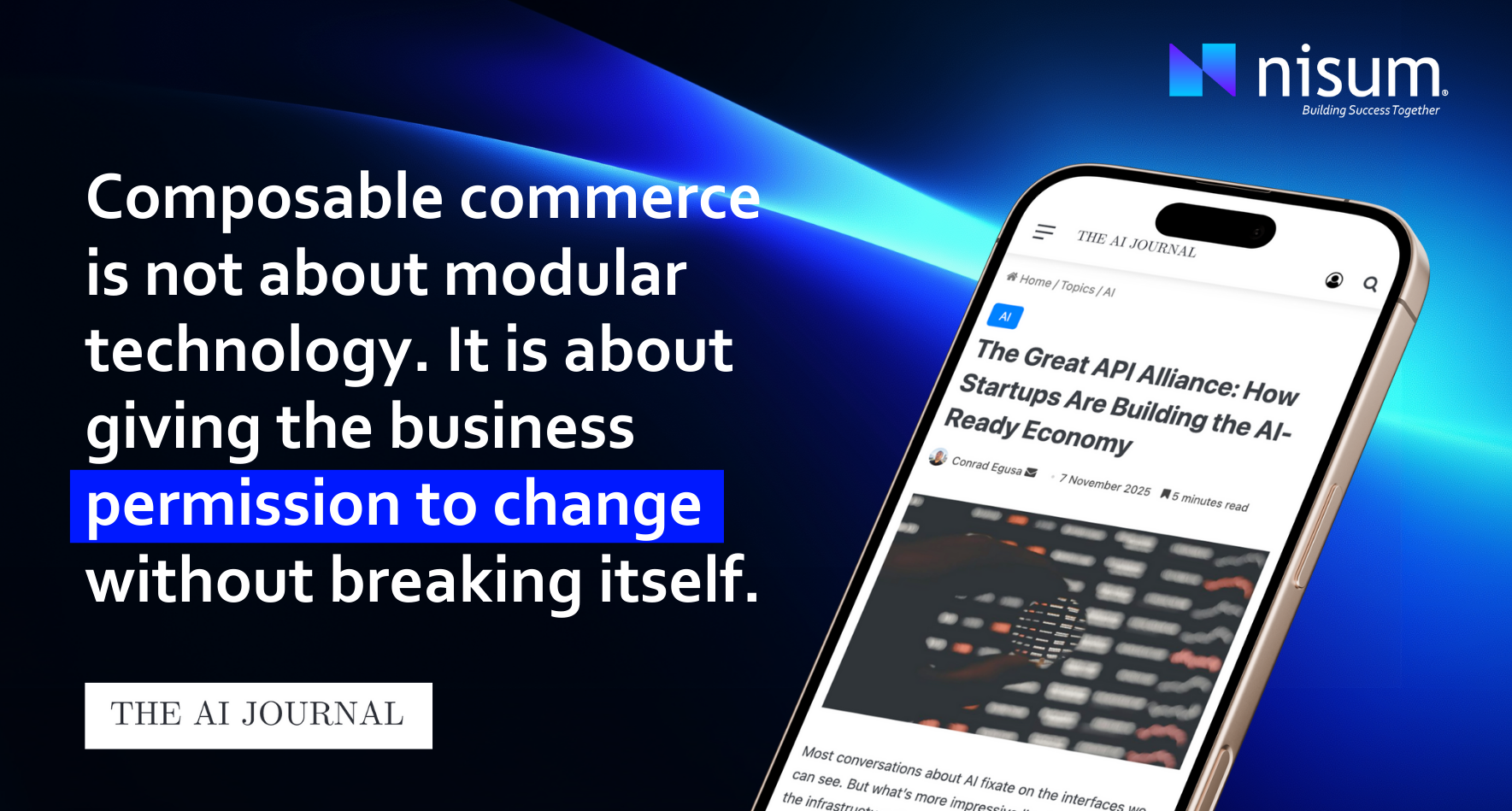
In a recent AI Journal article on “The Great API Alliance”, Nisum was highlighted in the context of a broader industry shift: scalable AI does not come from experimentation alone, but from strong API foundations that allow intelligence to be integrated, governed, and evolved across the business.
That shift is now clearly visible in the retail sector. The focus is no longer on whether AI matters, but on how AI-driven solutions become operational, scalable, and strategically aligned with the business. This is where two models converge: composable commerce and composable intelligence.
What Is Composable Commerce?
Composable commerce is a modular operating model for retail. Instead of locking critical capabilities like checkout, promotions, loyalty, or order management into a single platform, each capability operates as an independent component.
For business leaders, composable commerce enables:
-
Faster speed of change
-
Reduced transformation and platform risk
-
Greater flexibility to adapt to market and customer behavior shifts
This approach allows retailers to modernize continuously, without relying on large-scale replatforming initiatives.

What Is Composable Intelligence?
Composable intelligence applies the same modular principle to AI-driven solutions. Rather than deploying AI as a single centralized program, intelligence is delivered as scalable components embedded directly into business workflows.
These components may include recommendation engines, decisioning services, automation layers, or generative AI capabilities. From an executive perspective, the value lies in scalability with governance: the ability to expand AI adoption while maintaining control over cost, risk, and alignment with business objectives.
Together, composable commerce and composable intelligence allow organizations to evolve intelligence at the same pace as the business.
Composable commerce is what allows AI-driven intelligence to scale without breaking how retail operates.
Why APIs Matter for Scalable AI Solutions
APIs are no longer just an integration mechanism. In modern retail, they function as an operating model that determines how effectively AI solutions move from strategy to execution.
A mature API foundation allows organizations to:
-
Control where and how AI is applied
-
Scale intelligence incrementally instead of through disruptive change
-
Improve organizational speed while maintaining governance
-
Increase productivity by automating decisions, not just processes
From what we see at Nisum, API-driven architectures are a critical enabler of AI adoption that is both scalable and sustainable.
Shop Assist: An Example of Composable Intelligence in Action
Shop Assist demonstrates how composable intelligence delivers measurable business impact when deployed with intent. According to Nisum’s published data, the solution generated $18.6 million in incremental annualized sales and achieved an 88% positive interaction rate.
Rather than replacing existing systems, Shop Assist augments them. It integrates seamlessly into the commerce experience, enhancing product discovery and real-time decision-making through adaptive, human-centric interactions.
By deploying intelligence step-by-step, organizations improved customer engagement, reduced friction across digital journeys, and increased conversion without adding unnecessary complexity. Shop Assist functions as an intelligence layer that improves efficiency across the entire funnel.
The Future of Retail: Strategic Direction
Retail leaders are aligning around three core priorities:
-
Intelligence-forward customer journeys that increase relevance and speed
-
Unified commerce fabrics connecting channels, data, and intelligence
-
End-to-end decision augmentation across merchandising, pricing, fulfillment, and operations
Organizations designing for adaptability are outperforming those focused on isolated optimization.
Conclusion
The future of retail will not be defined by who adopts AI first, but by who integrates it best. By combining composable commerce with composable intelligence, organizations build a foundation for strategic clarity, operational efficiency, and sustained productivity gains.
In a market defined by constant change, competitive advantage comes from the ability to turn intelligence into execution at scale.
FAQ: Composable Commerce, AI Solutions, and Retail Transformation
What is composable commerce in retail?
Composable commerce is a modular architecture where retail capabilities operate independently, enabling faster change, lower risk, and continuous modernization.
What is composable intelligence?
Composable intelligence refers to deploying AI solutions as scalable, governed components embedded into business workflows rather than as isolated AI projects.
Why are APIs important for AI-driven retail?
APIs provide the foundation that allows AI solutions to integrate, scale, and evolve without disrupting core systems, enabling controlled and measurable AI adoption.
How does composable intelligence improve customer engagement?
By embedding intelligence directly into commerce journeys, retailers can deliver more relevant interactions, faster decisions, and smoother experiences across channels.
What business value do AI solutions like Shop Assist deliver?
AI solutions built on composable intelligence improve efficiency, productivity, and conversion. In the case of Shop Assist, this resulted in $18.6M in incremental annualized sales and an 88% positive interaction rate.