
<img height="1" width="1" style="display:none;" alt="" src="https://px.ads.linkedin.com/collect/?pid=7433348&amp;fmt=gif">
3 min read

AI Integration: Balancing Human Judgment and Machine Efficiency

Jan 7, 2026 5:56:45 AM

2026-01_Guillermo Delgado Authority Magazine Blog

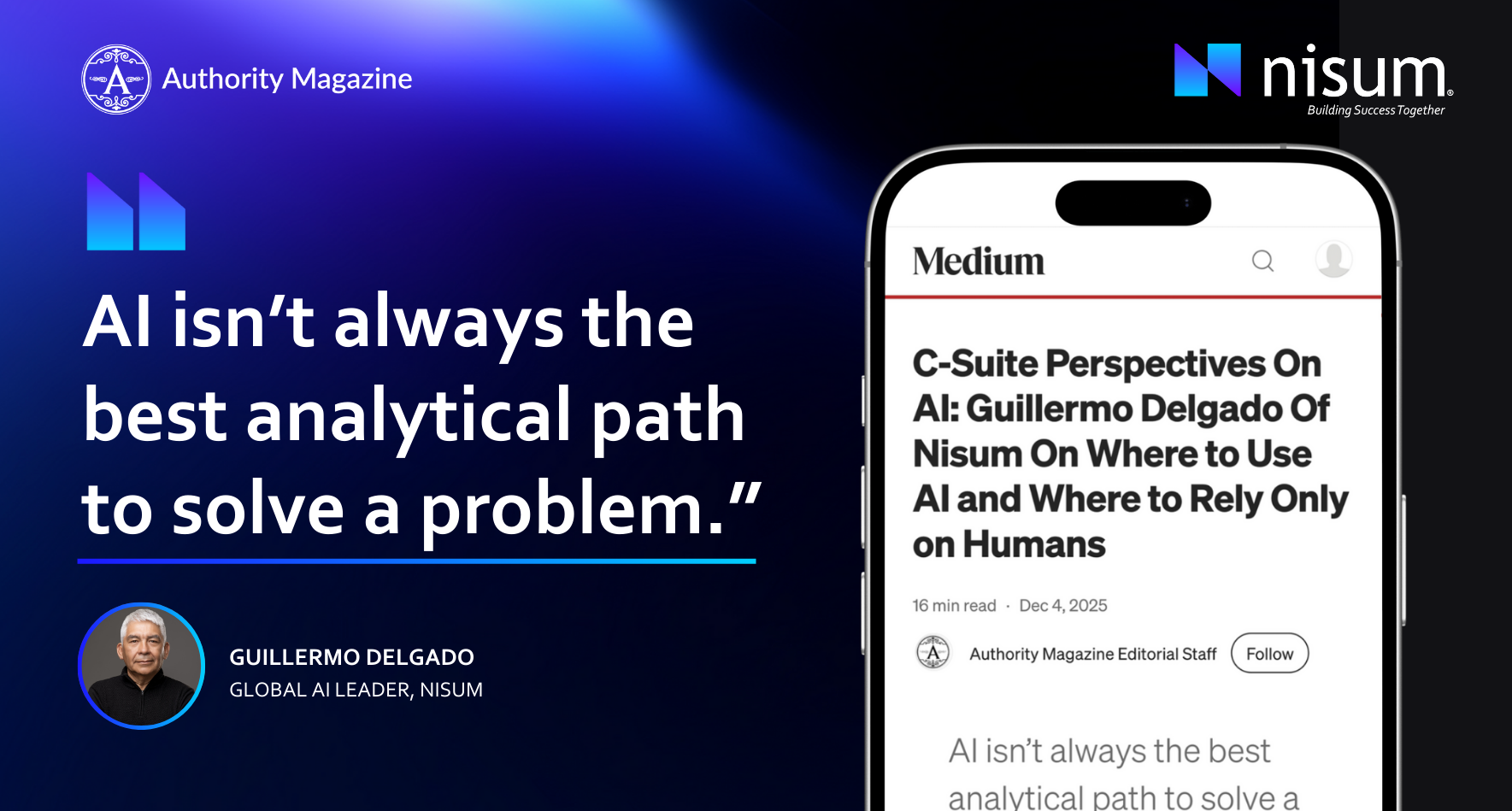
Authority Magazine just published an interview with our Global AI Leader, Guillermo Delgado, that lands where most AI coverage doesn’t: on the practical boundary between what sounds like AI and what actually works in enterprise settings. His central point is almost annoyingly useful: many “intelligent” outcomes come from analytics, optimization, and solid engineering discipline, not necessarily AI. The hype starts when we label everything AI and stop asking the harder question: what method solves this problem with the least risk and the most clarity?

AI vs humans: stop asking who wins, start asking what breaks

Guillermo frames AI as one tool in a broader toolkit. That matters because the cost of choosing the wrong tool isn’t just wasted spend, it’s governance debt: biased outputs, fragile decisions, and teams that defer judgment to a system they can’t fully explain.

Where AI is genuinely stronger

AI excels when the work is high-volume, repetitive, and language-heavy:

  • Summarizing and structuring large amounts of information
  • Drafting, categorizing, and synthesizing knowledge quickly
  • Accelerating execution in engineering workflows (review, testing support, QA patterns)

Used well, AI becomes a lever: it reduces cognitive busywork so humans can focus on decisions that actually change outcomes.

Where humans still win (and it’s not even close)

Humans outperform AI in the areas companies tend to underestimate until something goes wrong:

  • Context and judgment when data is incomplete, messy, or ambiguous
  • Creativity and disruption that breaks patterns instead of repeating them
  • Accountability and ethics, because responsibility can’t be delegated to a model

Delgado also points to a simple constraint: not everything that matters is available as training data, and not every “replacement” will be economically rational at scale.


2026-01_Authority Mag-IMG

Hybrid is the point: human judgment, machine scale

The best systems don’t replace people, they re-balance work. AI proposes, summarizes, and detects patterns. Humans validate, decide, and own the impact. That’s not just a safety posture, it’s a performance strategy.

And if you want AI to hold up outside the demo, governance has to be part of the design: transparency, privacy protection, bias awareness, and human oversight from the start.

Read the full interview

If you click through, there’s a lot more than the AI-vs-human framing. Delgado goes into his origin story (including an early “synthetic data” moment before the term was trendy), a funny-and-slightly-terrifying privacy lesson from customer profiling, and a real-world pricing case where a skeptical commercial leader becomes a believer after the model’s counterintuitive recommendation works. He also gets into responsible AI guardrails (bias, transparency, explainability) and shares examples of human + model collaboration that outperform either one alone, plus his “5 things to keep in mind” framework for deciding where AI belongs in the workflow. (Medium)


Nisum

Nisum

Founded in California in 2000, Nisum is a digital commerce company focused on strategic IT initiatives using integrated solutions that deliver real and measurable growth.

Have feedback? Leave a comment!

Featured

Blog by Topics

See All
3 minutos de lectura

AI Integration: Balancing Human Judgment and Machine Efficiency

Jan 7, 2026 5:56:45 AM

2026-01_Guillermo Delgado Authority Magazine Blog

Authority Magazine just published an interview with our Global AI Leader, Guillermo Delgado, that lands where most AI coverage doesn’t: on the practical boundary between what sounds like AI and what actually works in enterprise settings. His central point is almost annoyingly useful: many “intelligent” outcomes come from analytics, optimization, and solid engineering discipline, not necessarily AI. The hype starts when we label everything AI and stop asking the harder question: what method solves this problem with the least risk and the most clarity?

AI vs humans: stop asking who wins, start asking what breaks

Guillermo frames AI as one tool in a broader toolkit. That matters because the cost of choosing the wrong tool isn’t just wasted spend, it’s governance debt: biased outputs, fragile decisions, and teams that defer judgment to a system they can’t fully explain.

Where AI is genuinely stronger

AI excels when the work is high-volume, repetitive, and language-heavy:

  • Summarizing and structuring large amounts of information
  • Drafting, categorizing, and synthesizing knowledge quickly
  • Accelerating execution in engineering workflows (review, testing support, QA patterns)

Used well, AI becomes a lever: it reduces cognitive busywork so humans can focus on decisions that actually change outcomes.

Where humans still win (and it’s not even close)

Humans outperform AI in the areas companies tend to underestimate until something goes wrong:

  • Context and judgment when data is incomplete, messy, or ambiguous
  • Creativity and disruption that breaks patterns instead of repeating them
  • Accountability and ethics, because responsibility can’t be delegated to a model

Delgado also points to a simple constraint: not everything that matters is available as training data, and not every “replacement” will be economically rational at scale.


2026-01_Authority Mag-IMG

Hybrid is the point: human judgment, machine scale

The best systems don’t replace people, they re-balance work. AI proposes, summarizes, and detects patterns. Humans validate, decide, and own the impact. That’s not just a safety posture, it’s a performance strategy.

And if you want AI to hold up outside the demo, governance has to be part of the design: transparency, privacy protection, bias awareness, and human oversight from the start.

Read the full interview

If you click through, there’s a lot more than the AI-vs-human framing. Delgado goes into his origin story (including an early “synthetic data” moment before the term was trendy), a funny-and-slightly-terrifying privacy lesson from customer profiling, and a real-world pricing case where a skeptical commercial leader becomes a believer after the model’s counterintuitive recommendation works. He also gets into responsible AI guardrails (bias, transparency, explainability) and shares examples of human + model collaboration that outperform either one alone, plus his “5 things to keep in mind” framework for deciding where AI belongs in the workflow. (Medium)
Nisum

Nisum

Founded in California in 2000, Nisum is a digital commerce company focused on strategic IT initiatives using integrated solutions that deliver real and measurable growth.

¿Tienes algún comentario sobre este? Déjanoslo saber!

Destacados

Blogs por tema

See All