In modern software development, quality is non-negotiable. Yet for many organizations, ensuring it comes at a high price: overwhelmed QA teams, slow testing cycles, bugs slipping into production, and budgets that balloon with every sprint. Test automation presents itself as the obvious solution, but implementing it effectively and at scale remains one of the most complex challenges for engineering teams.
The problem is not the desire to automate. It is how it gets done.
When Testing Becomes a Bottleneck
In industries where delivery speed is critical, fragmented and late-stage QA processes create a domino effect that impacts the entire organization. Tests executed at the end of the development cycle, rather than integrated from the start, multiply the cost of fixing defects, slow down releases, and increase maintenance overhead.
Add to this siloed teams, weak feedback loops, and limited visibility into system performance, and the outcome becomes predictable: longer time-to-market, elevated operational overhead, and reduced organizational agility. Ultimately, customer experience and brand trust end up paying the price.
This was precisely the situation facing one of our clients: an organization dealing with late-stage testing processes, insufficient coverage, and a QA team spending a disproportionate amount of time on manual, repetitive tasks instead of focusing on what truly mattered.
The Solution: Qbric, AI-Driven QA Automation from Day One
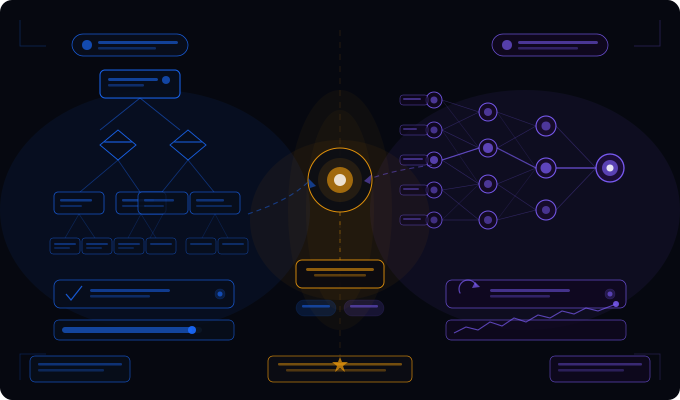
To address this challenge, we developed and deployed Qbric, our proprietary AI-powered test automation tool. Unlike traditional approaches, Qbric generates and executes test scripts directly from code, integrating validation from the earliest stages of development through an approach known as Shift-Left testing.
By automating testing flows and reducing manual intervention, Qbric accelerates delivery, improves reliability, and ensures consistent quality as products scale.
Its key capabilities include:
Faster Time-to-Market: Qbric automates script writing and test data generation, significantly accelerating testing and release cycles.
Improved Quality and Coverage: Self-healing scripts and comprehensive test scenarios reduce defects and increase system reliability, minimizing errors that reach production.
Lower Costs and Effort: By minimizing manual testing work and maintenance overhead, teams can redirect their energy toward higher-value tasks.
Centralized Visibility: Real-time reports provide actionable insights for better decision-making, with full traceability across all projects.
True Shift-Left Approach: Qbric does not just promise early defect detection, it delivers it, accelerating issue identification from the start and maximizing engineering team productivity by eliminating manual testing effort.
Measurable Results: Lower Costs, Greater Speed, Better Quality
The implementation of Qbric generated a tangible and measurable impact on the client's operations. The results speak for themselves:
- 30% decrease in operational costs, as a direct result of automating testing flows and eliminating redundant manual processes.
- 50% increase in team velocity, as engineers stopped spending time on repetitive tasks and were able to focus on high-value development work.
- 75% reduction in time-to-market, dramatically shortening validation and feature release cycles.
Beyond the metrics, the client achieved something harder to quantify but equally valuable: the confidence that every release meets consistent quality standards, regardless of how fast the product scales.
QA as a Competitive Advantage, Not an Obstacle
This success story reflects a reality that many software organizations face today: QA processes that are not integrated into the development flow will inevitably become a bottleneck. The question is not whether to automate testing, but when and how to do it in a way that generates real value.
Qbric, developed and backed by our expertise in software engineering and artificial intelligence, is the answer to that challenge. A tool designed not only for large teams with enterprise budgets, but for any organization that wants to turn QA into a growth lever rather than a point of friction.
If your team is dealing with testing bottlenecks, rising maintenance costs, or releases that cannot keep up with business demands, Qbric may be the turning point.