AI E-Commerce Consulting: A Practical Guide for Business and Technology Leaders
Only 5.5% of organizations using AI see real financial returns from their investments. That number should stop every commerce leader in their tracks, because it is not a statistic about pilots that failed to launch. It is a statistic about pilots that launched, ran, and produced nothing measurable.
The AI commerce opportunity is real. Gartner projects that 40% of enterprise applications will embed task-specific AI agents by the end of 2026, up from less than 5% in 2025. Retailers using AI at scale report 15% operational cost reductions and 10% revenue growth. But the gap between the average result and the top of the market is now enormous, and it is widening.
This guide is for the leaders trying to end up in the 5.5%. What follows is not a survey of AI features. It is an operator's view of what actually separates the initiatives that deliver from the ones that stall.
What AI E-Commerce Consulting Actually Covers
Most companies do not need help understanding AI. They need help translating AI into a specific set of commerce decisions their organization can actually execute. That is the work.
A capable AI e-commerce consulting engagement covers four things: a data readiness assessment that finds the gaps most companies miss until they are mid-project; vendor and platform selection that cuts through the marketing hype; custom model development for the use cases where off-the-shelf tools fall short; and the change management work that turns technology adoption into organizational capability.
The first of those is where most engagements should spend disproportionate time. AI is only as powerful as the data feeding it, and the data problem is almost always bigger than the client thinks. Skip that step and the rest of the program is running on borrowed time.
Why Native Platform Features Are Not the Whole Answer
Modern commerce platforms increasingly ship with built-in AI. That raises a fair question: if the platform already has AI, why bring in a consulting partner at all?
Native AI features are designed for the broadest possible audience. They handle generic tasks like generating product descriptions or offering "customers also bought" recommendations. What they cannot do is understand the specific nuances of an industry, the constraints of a complex supply chain, or the distinct voice of a brand.
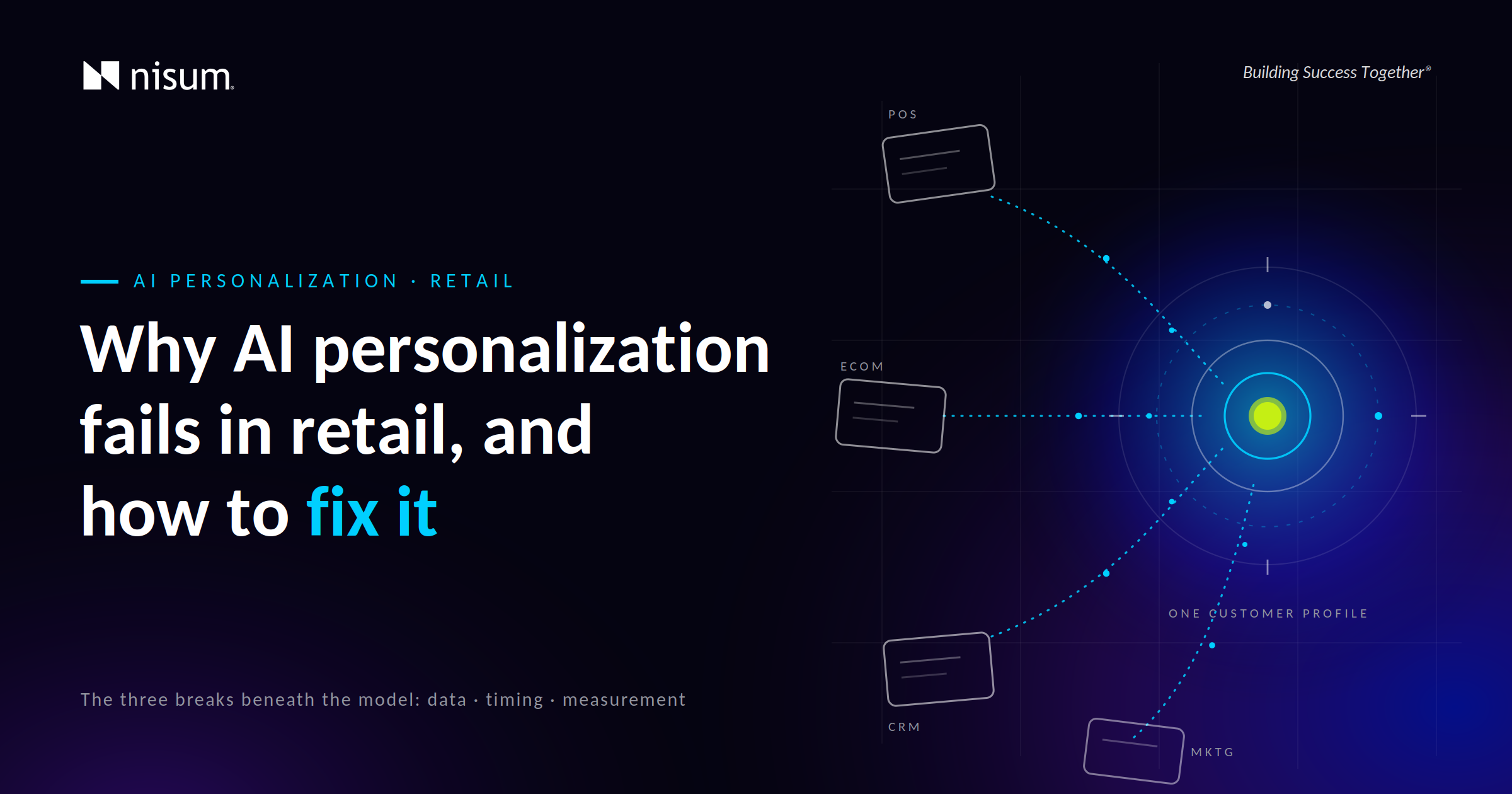
The bigger problem native features cannot solve is data silos. A marketing platform can have brilliant AI capabilities, but if it does not communicate with the inventory system, the business ends up promoting products that are out of stock. Solving that requires an integrated architecture where generative AI tools, predictive analytics, and automation platforms actually work together. That is architecture work, and it is where most companies hit the ceiling on what native features can deliver.
High-Impact Use Cases That Consistently Deliver
The playbook varies by business model, but a handful of use cases produce strong returns across B2B, B2C, and D2C formats.
Personalization Is the New Baseline
Personalization is no longer a differentiator. It is the price of admission. BCG research puts the revenue impact of AI-enabled retail experiences at a 5 to 15% conversion lift for retailers deploying first-party AI, and omnichannel personalization drives revenue growth of 5 to 15% across the customer base.
The frontier now is beyond product recommendations. Dynamic pricing models adjust based on demand, competitor activity, and inventory. Natural language search lets a customer look for "warm jackets for a rainy hiking trip" and get context-aware results rather than a keyword-matched list. Both are what personalization looks like when the underlying data is actually integrated.
Generative AI Has Changed Content Economics
Managing a large catalog used to require enormous manual effort. Generative AI has collapsed the cost. AI workflows now produce SEO-optimized product descriptions, localized marketing copy, and personalized email campaigns at a scale that would have been impossible two years ago.
Visual merchandising is being transformed as well. Brands are deploying tools that dynamically generate lifestyle images, adapting background and context to match the shopper's demographic profile. The engagement lift is meaningful, and the workload on marketing and design teams drops significantly.
Supply Chain Is Where the Real Money Is
Front-end personalization gets more attention, but back-end operations are usually where AI produces the biggest cost savings. McKinsey research shows AI-driven forecasting reduces supply chain errors by 20 to 50% and cuts lost sales from stockouts by up to 65%. Retailers using dynamic pricing agents report up to 10% profit improvement, 13% sales uplift during demand peaks, and 30% faster inventory turnover.
The compounding effect matters. Better forecasting reduces both holding costs and markdowns while improving product availability at peak demand. That combination is rare in retail operations, which is why supply chain use cases often produce the strongest business case for AI investment.
Why Most AI Initiatives Still Fail
Given the documented impact, why do most AI initiatives fall short? The failure patterns cluster into three.
Disjointed strategy. Marketing buys an AI copywriting tool. Logistics implements AI routing. Customer service deploys a chatbot. None of them share a unified data architecture, so the resulting customer experience is fragmented and sometimes worse than the pre-AI baseline. Every AI investment needs to tie back to a single measurable business objective. When technology serves the business strategy, this problem disappears. When it is the other way around, no amount of investment fixes it.
The data readiness bottleneck. The single most common failure point is data infrastructure. Sophisticated AI cannot be built on top of messy product data. If inventory counts are inaccurate or customer records are duplicated across three databases, machine learning models will amplify those errors at scale rather than fix them. Before advanced algorithms deploy, the data needs to be clean, structured, and centralized. That work is unglamorous. It is also non-negotiable.
Moving too fast without a foundation. The organizations that succeed treat AI adoption as a portfolio of bounded, measurable initiatives rather than a broad transformation program. Start with one high-impact, low-complexity use case. Prove value. Build the capability. Then scale. The pattern in failed initiatives is almost always the opposite: too many pilots, too little integration, no measurement, and no organizational capability to run the systems once they ship.
What ROI Actually Looks Like
Every conversation with finance eventually reaches the ROI question. The specific numbers vary based on scale and scope, but the returns fall into three categories.
Revenue growth: 15 to 25% conversion rate improvements from AI-driven personalization, plus meaningful lifts in customer lifetime value from targeted generative campaigns.
Cost reduction: 20 to 30% reductions in inventory holding costs from predictive supply chain, and 20 to 40% reductions in customer service overhead from intelligent routing and conversational AI.
Operational efficiency: faster decision cycles, less manual reconciliation, and the freeing of internal capacity for higher-value work.
The critical variable is measurement. Without baselines set on day one and clear attribution from each AI implementation to a specific business outcome, AI programs produce anecdotes rather than results. That is the single biggest reason projects with strong tools deliver weak ROI.
How to Choose the Right AI Consulting Partner
The AI consulting market is full of firms that lead with technology and follow with strategy. That order matters, and getting it wrong is expensive.
A few things worth demanding from any partner under evaluation:
They should not lead with tools. If the first conversation is about which platform or which model, that is a signal to keep looking. Good partners ask hard questions about revenue goals, competitive landscape, and operational bottlenecks before recommending any technology.
They should tell you what not to do. Every credible consulting engagement includes a list of use cases the client should deprioritize. If a partner will not tell you what to skip, they are selling scope rather than value.
They should build for handoff, not dependency. The right partner establishes governance, trains internal teams, and measures success by the client's ability to run the environment after the engagement ends. Partners that structure themselves around ongoing dependence eventually stop delivering fresh thinking.
They should have industry depth. A partner without commerce or retail context defaults to generic architecture patterns. That works for some use cases and fails for others. Ask for reference work in your specific industry and adjacent verticals. If it is thin, adjust expectations accordingly.
They should offer a bounded discovery phase before major commitment. A three to six week discovery that produces a clear portfolio map, a defensible budget, and a shortlist of prioritized use cases is worth more than any 18-month master plan signed on day one. The partners confident in their process do not need to sell the full engagement up front.
The best time to bring in a consulting partner is before making major platform investments, or the moment internal teams start spending more time managing data than acting on it. Waiting until the problem becomes urgent typically doubles both cost and risk.
Frequently Asked Questions
What is AI e-commerce?
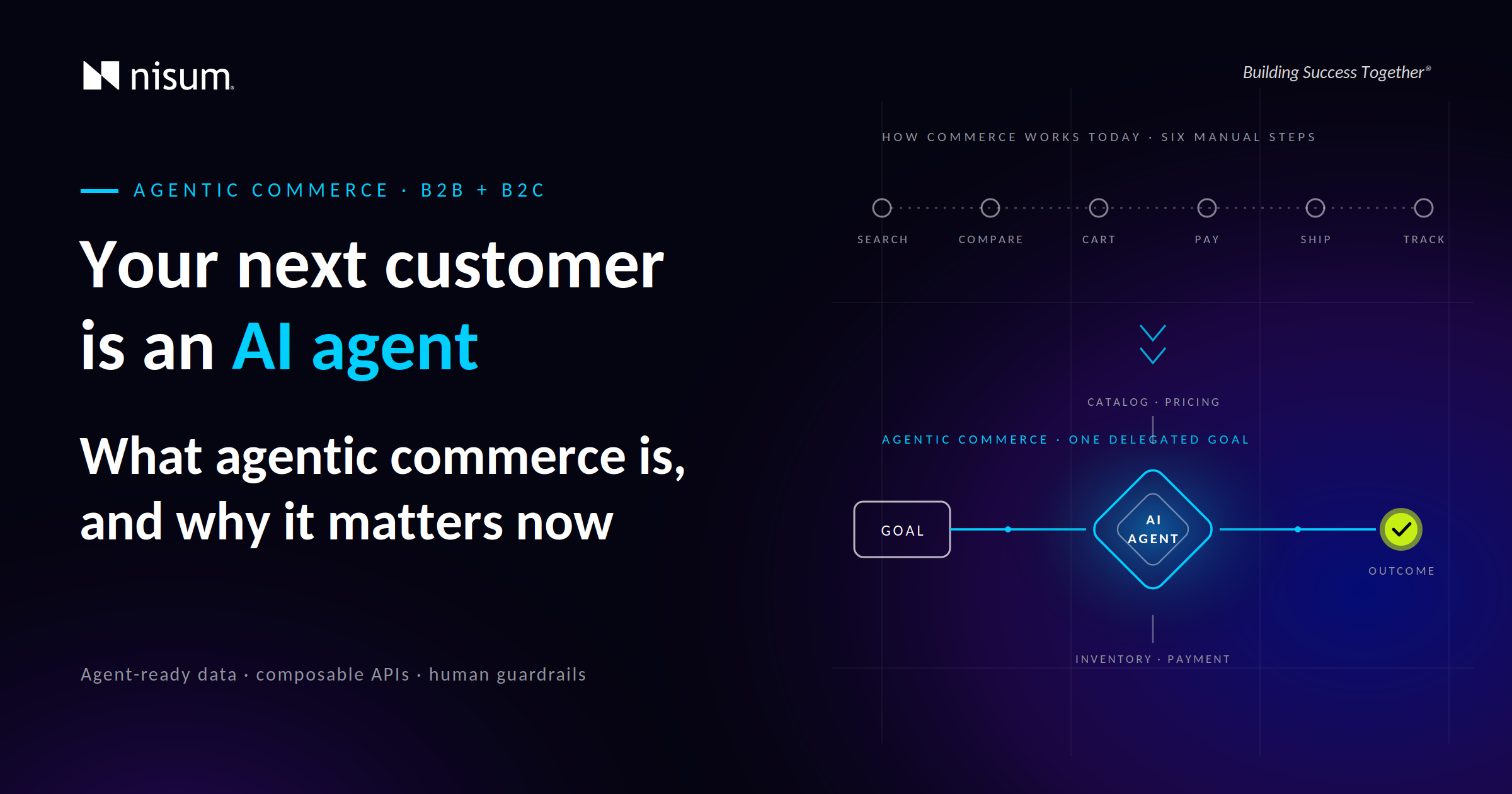
AI e-commerce is the application of machine learning, predictive analytics, generative AI, and autonomous agents across the retail value chain. It covers personalization, pricing, inventory management, content generation, and increasingly autonomous customer service.
What does an AI e-commerce consultant do?
An AI e-commerce consultant designs the strategy and architecture for AI-driven commerce transformation. That includes data readiness assessment, vendor and platform selection, custom model development, integration across enterprise systems, and change management to help internal teams operate the new capabilities.
Do I need a consulting partner if my e-commerce platform already has AI features?
Native AI features in commerce platforms handle generic tasks well but rarely deliver the depth required for enterprise transformation. Specialized consulting integrates data across the full enterprise, connects platform AI to inventory, CRM, and financial systems, and closes the data silo problems that limit what native features can achieve.
Why do most AI initiatives in e-commerce fail?
Industry research shows only 5.5% of organizations using AI see real financial returns. The most common failure patterns are disjointed AI investments that solve isolated problems, poor data infrastructure that undermines model quality, and moving too fast without a foundation of measurement and governance.
What is the typical ROI of AI in e-commerce?
Documented benefits include 15 to 25% conversion rate improvements from AI-driven personalization, 5 to 15% revenue lift from omnichannel personalization, 20 to 40% reduction in customer service overhead, and 20 to 30% reduction in inventory holding costs through predictive supply chain optimization. Realized ROI depends heavily on the scope of the deployment and the quality of measurement.
When should a company hire an AI e-commerce consultant?
The best times are before making major platform investments, when internal teams are spending more time managing data than acting on it, or when technology limitations start capping revenue growth. Waiting until problems become urgent typically raises both cost and risk.
What makes a good AI e-commerce consulting partner?
The strongest partners lead with business strategy rather than tool selection, tell clients what not to do, build for handoff rather than dependency, have industry-specific depth, and offer bounded discovery phases before requiring major commitment.
How long does an AI e-commerce transformation take?
A bounded initial use case can be operational in 3 to 6 months. Enterprise-wide AI commerce transformation typically runs 12 to 24 months, with most of that time going to data foundation work and organizational change rather than model development.