
<img height="1" width="1" style="display:none;" alt="" src="https://px.ads.linkedin.com/collect/?pid=7433348&amp;fmt=gif">
9 min read

How reliable is AI incident response? Proof and accuracy

Apr 27, 2026 12:57:54 PM

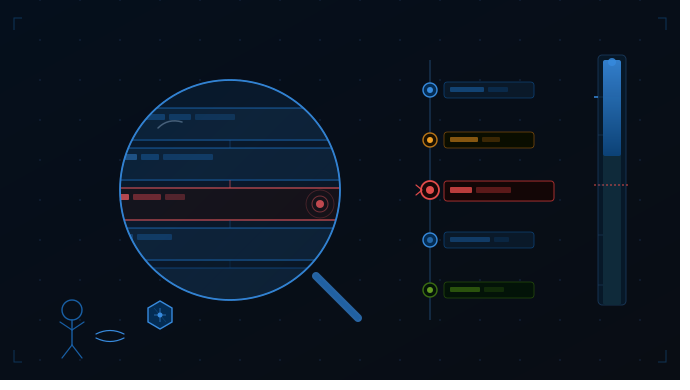
ai_incident_response_feature_graphic

When a critical system fails, every second puts your revenue, customer trust, and reputation at risk. If you’ve managed a “war room” situation, you know the scene: teams combing through logs, alerts, and metrics, pressured to find answers fast. Artificial Intelligence promises to accelerate incident response, surfacing the root cause in seconds. But, as a technology leader, you have a fair question, can you trust the AI to get it right? And, how can the AI prove its findings are credible?

This is not a theoretical concern. Entrusting an automated system to diagnose enterprise IT issues demands more than faith; it calls for concrete proof, transparent validation, and a solid grasp of how modern incident reporting software operates under real conditions. We work with clients who want the speed of AI but also require the reliability of their top engineers.

To bridge this gap, it’s essential to understand how AI conducts investigations. We’ll walk through the transparency mechanisms that set reliable AI solutions apart from the rest. By exploring causal reasoning, reproducible audit trails, confidence scoring, and the importance of human oversight, you’ll have a framework for absolute trust in AI-powered operations.

The Evolution of Root Cause Analysis and the Need for AI

Why is AI now indispensable in incident management? Modern enterprise systems are complex. A customer’s request may pass through a load balancer, microservices, message queues, and several databases. When something fails, the flood of alerts can overwhelm even seasoned teams.

Traditionally, human operators try to connect the dots manually, pulling logs, matching timestamps, and using past experience. This manual process invites errors, delays resolution, and often leads to misdiagnosing symptoms as root causes. For example, a spike in database CPU usage may prompt a restart, when the real issue was a faulty microservice query.

AI changes this paradigm. Advanced algorithms and machine learning models analyze millions of data points across your environment—instantly. They recognize patterns and relationships that manual review will miss.

Yet, high-volume data processing is not enough. Accuracy depends on the AI’s ability to reason causally about the actual chain of events. The recommendations must address the core issue, not just its symptoms. Trustworthy AI incident management rests on proof, transparency, and precision.

How AI Analyzes Incidents to Identify the True Root Cause

So, can AI do root cause analysis accurately? Yes, but the methodology matters immensely. True AI incident investigation relies on deterministic logic combined with probabilistic pattern matching. It does not just look for things that happened at the same time. It looks for cause and effect.

When an anomaly arises, the AI initiates a structured investigation, mapping your network topology and understanding service dependencies. If Service A depends on Service B, and B is leaking memory, the AI will pinpoint the source, recognizing that latency in A is a downstream effect.

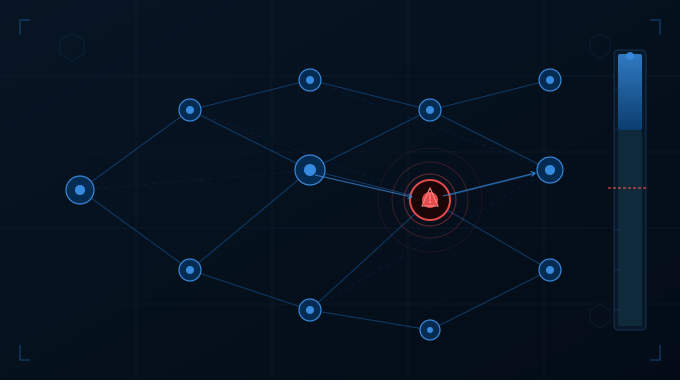
To accomplish this, leading solutions use knowledge graphs that represent every asset and connection in your IT environment. When an incident strikes, the AI overlays logs, metrics, and trace data onto this graph to identify the origin, tracing degradation back from failure to root cause.

For instance, consider a global retailer who faced a rapid drop in online checkout conversions. Traditional monitoring generated dozens of disconnected alerts, payment timeouts, database errors, and frontend latency. The AI-driven platform mapped these events, identifying that an innocuous change to load balancer routing hours earlier caused a slow network degradation. The AI spotted the sequence because it understood the relationships behind the alerts.

Automated, detailed analysis enables your teams to act immediately. Operations shift from reactive firefighting to strategic resolution. But identification isn’t enough. The AI must then show stakeholders clear evidence supporting its findings.

The Proof is in the Process: Validation and Transparency Mechanisms

A “black box” AI that spits out an answer without explanation is a nonstarter in enterprise IT. Trust demands rigorous transparency. How do you know if the AI is accurate? Insist on evidence.

Modern AI incident tools prove their findings through several mechanisms:

1. Causal Chains: The AI shows the full sequence of events, timestamps, system changes, and resulting effects. For example, a timeline that demonstrates code patch deployment at 10:02 AM, resource spikes at 10:05, and database pool exhaustion at 10:12. This lets teams verify the logic.

2. Confidence Scoring: The system attaches confidence percentages to each finding. A 99 percent score means your team can automate fixes with assurance; a 65 percent score signals a need for human review. Managing risk becomes straightforward.

3. Reproducibility: Feed the same data in, and the AI delivers the same actions. This consistency is vital, especially around regulatory or sensitive environments, where reproducibility is non-negotiable.

4. Source Data Linking: The AI provides deep links to the original logs or metrics supporting its conclusion. Every claim is rooted in real operational data, no guesses.

Integrating AI with Incident Reporting Software

For maximum value, AI must integrate tightly with your incident reporting software. This system tracks every issue, response, and resolution, forming your organization’s single source of truth.

When AI identifies a root cause, it should auto-populate incident reports with all relevant details: event timeline, affected systems, root cause, and corrective actions. This lifts the reporting burden from your engineers and brings consistency to every review.

Over time, integration builds a rich AI incident database. The AI learns contextual quirks, knowing, for example, that CPU spikes on a legacy server during nightly backups are routine and don’t require action. Your AI continually improves with your environment.

AI-driven reports also improve stakeholder communications. When outages occur, leaders don’t want jargon, they want a clear summary of what happened, why, and how you’ll prevent it next time. AI condenses technical details into business-focused insights that enable strong decision-making and demonstrate the return on your IT investment.

The Four Stages of AI Driven Incident Response

AI’s impact spans all four recognized stages of incident response:

1. Preparation and Detection: Traditional detection uses static thresholds. AI adopts dynamic baselining, learning normal patterns over time and detecting subtle anomalies before failure strikes. This foresight dramatically reduces your risk profile.

2. Containment, Analysis, and Investigation: AI shines here. It instantly correlates events across your entire environment, pinpoints the problematic component, and compresses hours of manual analysis into seconds, helping teams minimize impact.

3. Eradication and Remediation: With root cause identified and high confidence indicated, AI can initiate automated workflows, restart services, roll back deployments, or block malicious access. This reduces your Mean Time To Resolve dramatically.

4. Post Incident Activity: After events, AI auto-generates thorough incident documentation, highlights vulnerable areas, and extracts learnings from historical data to fortify your architecture.

Human in the Loop: The Indispensable Partnership

AI is a tool to elevate, not replace, human expertise. Your engineers and analysts contribute vital business context AI cannot match. For instance, while the AI may suggest shutting down a payroll server to block a threat, a human recognizes the operational impact and weighs alternatives.

We believe in a “Human in the Loop” model, affirming that AI powers analysis and recommendations, but people make the critical calls. Your teams review the timeline, evidence, and causal logic, then decide the final course of action. This preserves accountability, trust, and strategic oversight.

Human feedback also drives AI improvement. When engineers validate an AI finding or correct it, the model learns. Over time, this feedback loop increases accuracy and trustworthiness.

Key Metrics to Evaluate AI Accuracy

Adopting AI incident response tools means measuring success beyond vendor promises. Look at concrete metrics:

  • Mean Time To Detect (MTTD): How quickly does AI flag an anomaly versus traditional tools? A modern platform should detect issues far earlier.
  • Mean Time To Resolve (MTTR): How much faster is incident resolution after deploying AI? MTTR should drop noticeably, reflecting true root cause accuracy.
  • False Positive Rate: Does the AI minimize unnecessary alerts? A low false positive rate keeps teams engaged and focused.
  • First Time Fix Rate: When AI recommends corrective action, does the issue stay resolved? An accurate AI delivers a high rate of permanent fixes, avoiding repeated incidents.

Tracking these KPIs validates if your AI solution truly delivers value.

Implementing a Culture of Trust and Transparency

Successful AI deployment requires more than technology, it demands cultural change. Your engineers and leaders must understand how the AI works and why its logic holds up.

Build this culture with transparency. Offer hands-on training in core AI concepts: deterministic logic, probabilistic modeling, and confidence scoring. When your teams grasp the mechanics, trust grows.

Roll out AI incrementally. Start with advisory-only settings. Let AI and human experts both complete analyses. Measure, document, and compare results. As the AI demonstrates consistent accuracy, expand automated responses for well-understood, low-risk scenarios.

Capture validation data in your reporting software: track confidence scores, document human overrides, and build an audit trail. This objective record shows stakeholders the real-world value and reliability of the AI.

Elevating Operations to the Next Level

Complexity in enterprise IT is only intensifying. Cloud-native systems, microservices, and global infrastructure make old-school root cause analysis impractical. To keep your operations resilient, secure, and agile, AI-powered incident response is no longer optional.

But you should never settle for a black box. Demand transparency, causal logic, and tangible evidence. Prioritize AI solutions that give you complete audit trails, confidence scoring, and seamless integration with your incident reporting tools.

We understand this transition takes partnership and expertise. You need technology that matches your environment and empowers your people, not one-size-fits-all automation. We help clients move from reactive firefighting to proactive, data-driven operations, reducing downtime, cutting alert fatigue, and strengthening trust in their IT.

It’s time to leave manual, error-prone incident management behind. Advance to transparent, actionable, and highly accurate root cause analysis. If you’re ready to see how this transformation works in practice, explore OpsRabbit. Discover how you can empower your teams and secure your operations with clarity, confidence, and measurable business outcomes.
Ready to unlock your next digital advantage?

FAQ: Incident Investigation

What is an incident investigation?

An incident investigation is a structured process we use with you to uncover what happened, why it happened, and how to prevent it from happening again. We work side by side with your team, gathering facts and evidence to build a clear picture of the incident.

Why should we conduct an incident investigation?

Investigating incidents helps you protect your people, assets, and reputation. By understanding root causes, your organization can fix gaps, reduce risk, and show teams that safety and improvement matter.

How long does an incident investigation take?

Timelines vary based on complexity, but we act quickly. Simple cases may be resolved in a few days, while more complex issues may take a few weeks.

Nisum

Nisum

Founded in California in 2000, Nisum is a digital commerce company focused on strategic IT initiatives using integrated solutions that deliver real and measurable growth.

Have feedback? Leave a comment!

Featured

Blog by Topics

See All
9 minutos de lectura

How reliable is AI incident response? Proof and accuracy

Apr 27, 2026 12:57:54 PM

ai_incident_response_feature_graphic

When a critical system fails, every second puts your revenue, customer trust, and reputation at risk. If you’ve managed a “war room” situation, you know the scene: teams combing through logs, alerts, and metrics, pressured to find answers fast. Artificial Intelligence promises to accelerate incident response, surfacing the root cause in seconds. But, as a technology leader, you have a fair question, can you trust the AI to get it right? And, how can the AI prove its findings are credible?

This is not a theoretical concern. Entrusting an automated system to diagnose enterprise IT issues demands more than faith; it calls for concrete proof, transparent validation, and a solid grasp of how modern incident reporting software operates under real conditions. We work with clients who want the speed of AI but also require the reliability of their top engineers.

To bridge this gap, it’s essential to understand how AI conducts investigations. We’ll walk through the transparency mechanisms that set reliable AI solutions apart from the rest. By exploring causal reasoning, reproducible audit trails, confidence scoring, and the importance of human oversight, you’ll have a framework for absolute trust in AI-powered operations.

The Evolution of Root Cause Analysis and the Need for AI

Why is AI now indispensable in incident management? Modern enterprise systems are complex. A customer’s request may pass through a load balancer, microservices, message queues, and several databases. When something fails, the flood of alerts can overwhelm even seasoned teams.

Traditionally, human operators try to connect the dots manually, pulling logs, matching timestamps, and using past experience. This manual process invites errors, delays resolution, and often leads to misdiagnosing symptoms as root causes. For example, a spike in database CPU usage may prompt a restart, when the real issue was a faulty microservice query.

AI changes this paradigm. Advanced algorithms and machine learning models analyze millions of data points across your environment—instantly. They recognize patterns and relationships that manual review will miss.

Yet, high-volume data processing is not enough. Accuracy depends on the AI’s ability to reason causally about the actual chain of events. The recommendations must address the core issue, not just its symptoms. Trustworthy AI incident management rests on proof, transparency, and precision.

How AI Analyzes Incidents to Identify the True Root Cause

So, can AI do root cause analysis accurately? Yes, but the methodology matters immensely. True AI incident investigation relies on deterministic logic combined with probabilistic pattern matching. It does not just look for things that happened at the same time. It looks for cause and effect.

When an anomaly arises, the AI initiates a structured investigation, mapping your network topology and understanding service dependencies. If Service A depends on Service B, and B is leaking memory, the AI will pinpoint the source, recognizing that latency in A is a downstream effect.

To accomplish this, leading solutions use knowledge graphs that represent every asset and connection in your IT environment. When an incident strikes, the AI overlays logs, metrics, and trace data onto this graph to identify the origin, tracing degradation back from failure to root cause.

For instance, consider a global retailer who faced a rapid drop in online checkout conversions. Traditional monitoring generated dozens of disconnected alerts, payment timeouts, database errors, and frontend latency. The AI-driven platform mapped these events, identifying that an innocuous change to load balancer routing hours earlier caused a slow network degradation. The AI spotted the sequence because it understood the relationships behind the alerts.

Automated, detailed analysis enables your teams to act immediately. Operations shift from reactive firefighting to strategic resolution. But identification isn’t enough. The AI must then show stakeholders clear evidence supporting its findings.

The Proof is in the Process: Validation and Transparency Mechanisms

A “black box” AI that spits out an answer without explanation is a nonstarter in enterprise IT. Trust demands rigorous transparency. How do you know if the AI is accurate? Insist on evidence.

Modern AI incident tools prove their findings through several mechanisms:

1. Causal Chains: The AI shows the full sequence of events, timestamps, system changes, and resulting effects. For example, a timeline that demonstrates code patch deployment at 10:02 AM, resource spikes at 10:05, and database pool exhaustion at 10:12. This lets teams verify the logic.

2. Confidence Scoring: The system attaches confidence percentages to each finding. A 99 percent score means your team can automate fixes with assurance; a 65 percent score signals a need for human review. Managing risk becomes straightforward.

3. Reproducibility: Feed the same data in, and the AI delivers the same actions. This consistency is vital, especially around regulatory or sensitive environments, where reproducibility is non-negotiable.

4. Source Data Linking: The AI provides deep links to the original logs or metrics supporting its conclusion. Every claim is rooted in real operational data, no guesses.

Integrating AI with Incident Reporting Software

For maximum value, AI must integrate tightly with your incident reporting software. This system tracks every issue, response, and resolution, forming your organization’s single source of truth.

When AI identifies a root cause, it should auto-populate incident reports with all relevant details: event timeline, affected systems, root cause, and corrective actions. This lifts the reporting burden from your engineers and brings consistency to every review.

Over time, integration builds a rich AI incident database. The AI learns contextual quirks, knowing, for example, that CPU spikes on a legacy server during nightly backups are routine and don’t require action. Your AI continually improves with your environment.

AI-driven reports also improve stakeholder communications. When outages occur, leaders don’t want jargon, they want a clear summary of what happened, why, and how you’ll prevent it next time. AI condenses technical details into business-focused insights that enable strong decision-making and demonstrate the return on your IT investment.

The Four Stages of AI Driven Incident Response

AI’s impact spans all four recognized stages of incident response:

1. Preparation and Detection: Traditional detection uses static thresholds. AI adopts dynamic baselining, learning normal patterns over time and detecting subtle anomalies before failure strikes. This foresight dramatically reduces your risk profile.

2. Containment, Analysis, and Investigation: AI shines here. It instantly correlates events across your entire environment, pinpoints the problematic component, and compresses hours of manual analysis into seconds, helping teams minimize impact.

3. Eradication and Remediation: With root cause identified and high confidence indicated, AI can initiate automated workflows, restart services, roll back deployments, or block malicious access. This reduces your Mean Time To Resolve dramatically.

4. Post Incident Activity: After events, AI auto-generates thorough incident documentation, highlights vulnerable areas, and extracts learnings from historical data to fortify your architecture.

Human in the Loop: The Indispensable Partnership

AI is a tool to elevate, not replace, human expertise. Your engineers and analysts contribute vital business context AI cannot match. For instance, while the AI may suggest shutting down a payroll server to block a threat, a human recognizes the operational impact and weighs alternatives.

We believe in a “Human in the Loop” model, affirming that AI powers analysis and recommendations, but people make the critical calls. Your teams review the timeline, evidence, and causal logic, then decide the final course of action. This preserves accountability, trust, and strategic oversight.

Human feedback also drives AI improvement. When engineers validate an AI finding or correct it, the model learns. Over time, this feedback loop increases accuracy and trustworthiness.

Key Metrics to Evaluate AI Accuracy

Adopting AI incident response tools means measuring success beyond vendor promises. Look at concrete metrics:

  • Mean Time To Detect (MTTD): How quickly does AI flag an anomaly versus traditional tools? A modern platform should detect issues far earlier.
  • Mean Time To Resolve (MTTR): How much faster is incident resolution after deploying AI? MTTR should drop noticeably, reflecting true root cause accuracy.
  • False Positive Rate: Does the AI minimize unnecessary alerts? A low false positive rate keeps teams engaged and focused.
  • First Time Fix Rate: When AI recommends corrective action, does the issue stay resolved? An accurate AI delivers a high rate of permanent fixes, avoiding repeated incidents.

Tracking these KPIs validates if your AI solution truly delivers value.

Implementing a Culture of Trust and Transparency

Successful AI deployment requires more than technology, it demands cultural change. Your engineers and leaders must understand how the AI works and why its logic holds up.

Build this culture with transparency. Offer hands-on training in core AI concepts: deterministic logic, probabilistic modeling, and confidence scoring. When your teams grasp the mechanics, trust grows.

Roll out AI incrementally. Start with advisory-only settings. Let AI and human experts both complete analyses. Measure, document, and compare results. As the AI demonstrates consistent accuracy, expand automated responses for well-understood, low-risk scenarios.

Capture validation data in your reporting software: track confidence scores, document human overrides, and build an audit trail. This objective record shows stakeholders the real-world value and reliability of the AI.

Elevating Operations to the Next Level

Complexity in enterprise IT is only intensifying. Cloud-native systems, microservices, and global infrastructure make old-school root cause analysis impractical. To keep your operations resilient, secure, and agile, AI-powered incident response is no longer optional.

But you should never settle for a black box. Demand transparency, causal logic, and tangible evidence. Prioritize AI solutions that give you complete audit trails, confidence scoring, and seamless integration with your incident reporting tools.

We understand this transition takes partnership and expertise. You need technology that matches your environment and empowers your people, not one-size-fits-all automation. We help clients move from reactive firefighting to proactive, data-driven operations, reducing downtime, cutting alert fatigue, and strengthening trust in their IT.

It’s time to leave manual, error-prone incident management behind. Advance to transparent, actionable, and highly accurate root cause analysis. If you’re ready to see how this transformation works in practice, explore OpsRabbit. Discover how you can empower your teams and secure your operations with clarity, confidence, and measurable business outcomes.

Ready to unlock your next digital advantage?

FAQ: Incident Investigation

What is an incident investigation?

An incident investigation is a structured process we use with you to uncover what happened, why it happened, and how to prevent it from happening again. We work side by side with your team, gathering facts and evidence to build a clear picture of the incident.

Why should we conduct an incident investigation?

Investigating incidents helps you protect your people, assets, and reputation. By understanding root causes, your organization can fix gaps, reduce risk, and show teams that safety and improvement matter.

How long does an incident investigation take?

Timelines vary based on complexity, but we act quickly. Simple cases may be resolved in a few days, while more complex issues may take a few weeks.
Nisum

Nisum

Founded in California in 2000, Nisum is a digital commerce company focused on strategic IT initiatives using integrated solutions that deliver real and measurable growth.

¿Tienes algún comentario sobre este? Déjanoslo saber!

Destacados

Blogs por tema

See All